Showing posts with label Rosa Parks. Show all posts

Tuesday, March 2, 2010

Rosa Parks


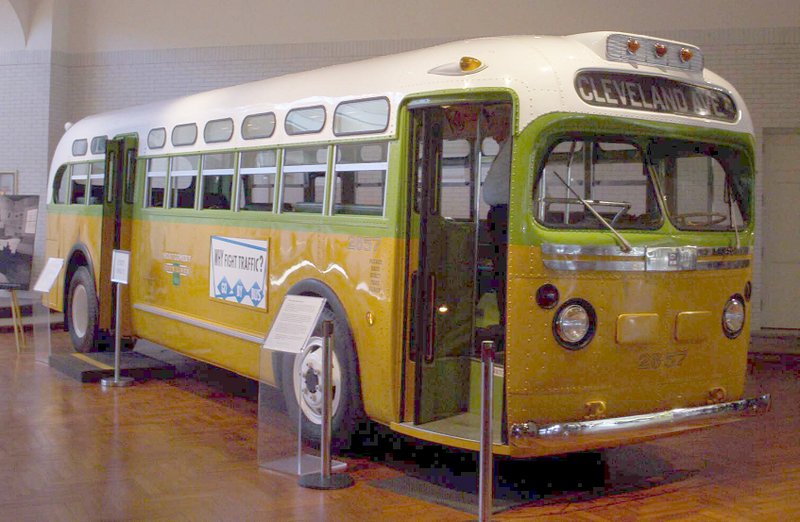
On a cold December 1st night in 1955, Rosa Louise McCauley Parks was leaving work for her Montgomery home. Because she was black, Rosa parks was forced to sit at the back of the bus, like other black people of her time. However, she dared to rebel against the norm, and refused to give up her spot. On that December night, Rosa Parks was in the front of the bus when a white man stepped on. The bus driver ordered her to give up her seat to the white man, but she refused. A police officer arrested her, and she was taken away to jail.

Rosa Parks’ defiance of the law sparked a city-wide bus boycott by colored people all around Montgomery. Her act became an important symbol of the modern day civil rights movement and propelled her into international fame. She received many medals for her act, including the Congressional Medal of Honor and the Spingarn Medal in 1979. Upon her death in 2005, Rosa Parks was granted the posthumous honor of lying in sate at the Capital Rotunda.

Rosa Parks was a very courageous figure. A symbol for generations to come, she stood up to an unfair and unjust law for her own beliefs and for her cause. Like Martin Luther King and other Civil Rights leaders, she sacrificed everything, losing her job and getting arrested in the process. She sat for equality, so future generations could stand tall.

By: Yotam Kasznik and Jonas Pinnau

Rosa Parks

Rosa Parks

Rosa Parks was a proud black woman from birth. Her earlier years were fairly decent, due to the kind white people around the area. She first became aware to the racism when the KKK marched down her street to make a point to all the black people in the neighborhood. As she became more active for the cause against the racism in America, she joined the NAACP, a strong activist group fighting the racism everywhere. She was outrage by incident with the 15-year-old black girl refusing to leave the bus. This encouraged her to act upon the anger the black people were holding in due to this incident. Her first response was the same action, just with more at stake. When she refused to get off the white section of the bus. When she did that she was able to start the Montgomery Bus Boycott. This devastated the Bus Transportation System.

Monday, March 1, 2010

Rosa Parks


Rosa Parks would become known for her action of refusing to relinquish her seat on the bus to a white man on December 1, 1955 and starting a boycott that would bring even more attention to the civil rights movement. The boycott would last 381 days, approximately one year, and forced the Supreme Court to outlaw segregation. But before her actions on the buss, she had already began to fight segregation. She protested segregation through daily actions, such as refusing to use segregated facilities. In 1943, she joined the Montgomery chapter of the NAACP. When, in 1955, she attended a workshop to promote interracial living, she decided to attempt to fight segregation even more publicly. Rosa Parks would go on to become one of several icons of the Civil Rights Movement. It would cause her many hardships, and as she grew older, she grew increasingly removed from the movement.

Tuesday, February 23, 2010

The Montgomery Bus Boycott


Rosa Parks was born in 1913. She was an activist for African American civil rights who worked with the NAACP and many individual civil rights leaders, including Martin Luther King, Jr. However, she was most famous for starting the Montgomery Bus Boycott. On December 1, 1955, Parks refused to give up her seat on a bus for a white person. This type of protest had been done before, but the other protests had not caused boycotts.

Technically, Parks had not even broken any laws. The buses were segregated and drivers were allowed to assign seats to keep them that way, but they could not make people move or stand if the bus got full. However, because racism was so prevalent, it had become common practice for bus drivers to make black people give up their seats if there were white people who would have to stand if they didn't. Parks was arrested even though she had not broken any laws by refusing to give up her seat.

E.D. Nixon, a civil rights activist, and Clifford Durr, the lawyer who would later represent Parks, bailed her out of jail the next day. Nixon then contacted a member of the Women's Political Council (WPC), which then became the first organization to officially support the Montgomery Bus Boycott. The Montgomery Improvement Association (MIA) was formed to lead the boycott. Martin Luther King, Jr was chosen as the organization's leader. This boycott raised awareness of the injustices being done to African Americans and paved the way for many other civil rights movements.

~By Erin M

Rosa Parks and Her Struggle


On December 1st, 1955, four African American's were asked to move to the specified "colored" section, so that a white man could sit without having to sit next to any African Americans.  Rosa Parks, a seamstress and a NAACP officer, was on of those passengers.  Although, when asked to move, unlike the other passengers, she refused.  And due to this simple act of rebellion, she was arrested.  
NAACP leader, E. D. Nixon,  and Jo Ann Robinson decided to boycott the busses.  Together the African American community formed the Montgomery Improvement association to pursue the boycott. They elected Martin Luther Kind Jr. as the leader of their group.  
On December 5th, 1955, King made a declaration to a crowd ranging from 5000-15000 people. Because of this empowering speech, African Americans filed a lawsuit and refused to ride the busses in Montgomery for 381 days. Other than the African American community, there were many supporters of the boycott.  This included sympathetic white southerners, Montgomery's Jewish community, and Union Auto Workers.  In 1956, the supreme court outlawed bus segregation.  
One woman's determination to change the rules of society, the beginnings of a greater struggle for equality began.   

~Sneha and Alice

Rosa Parks


ROSA PARKS

Rosa was born on Feb. 4, 1913 in Tuskegee, Alabama. In December 1955, Rosa had just finished a tiring day of work as a seamstress and got on the bus. The bus driver said that blacks had to get up so that whites could sit down and Rosa said no. She was then arrested for violating the segregation laws and removed from the bus. She was a very active member of the NAACP and played a huge role in the bus boycott where blacks refused to take buses to stand up for their rights. In 1956, the Supreme Court voted on Browder v. Gayle and they decided segregation on the buses was unconstitutional and the buses were integrated. Rosa was an icon of the Civil Rights Movement and formed the Rosa L. Parks Scholarship Foundation that aids college bound seniors. At the age of 81, Rosa was attacked in her home by Joseph Skipper who was a drug addict. Rosa died in Detroit on October 24, 2005 at an age of 92. She had been diagnosed with dementia the previous year. 


Petra 


Rosa Parks By: Diane Jung

Rosa Parks (1913-2005) is best recognized as the brave seamstress who refused to ride on the back of a bus to make room for a white passenger on December 1, 1955. Although she was arrested and fined for this, Parks' act of defiance led to the Montgomery Bus Boycott. This boycott lasted 382 days and
Rosa Parks was born in Tuskegee, Alabama and attended the private school called the Montgomery Industrial School for Girls. She persisted despite the fear that she and her family lived in and took every opportunity she had to better her fortunes. She eventually graduated from the Alabama State Teachers College and then settled with her husband, Raymond Parks. Both Rosa and Raymond Parks joined the NAACP and helped their locals in various trials related to murder, flogging, peonage, and rape. Along with her work in the NAACP, Parks had an award in her honor, the Rosa Parks Freedom Award, founded the Rosa and Raymond Parks Institute for Self-Development, was awarded the Presidential Medal of Freedom by Clinton, and also received the Congressional Gold Medal.
Parks lived the rest of her life in peace in Detroit and died on October 24, 2005. Her casket was placed in the rotunda of the United States Capitol for two days, an honor left for United States presidents.
Rosa Parks influenced and changed the lives of many and will forever be remembered as a pioneer in American History.