Showing posts with label The Space Race. Show all posts

Wednesday, April 28, 2010

Space Program in the 1960's


The 60's was an anxious time for the U.S. involving space. They feared they were falling behind in development of intercontinental ballistic missiles and that the missile gap was increasing between the Soviet Union and the U.S.. Once John F. Kennedy was elected president he had no choice, but to focus on human spaceflight. 
On April 12, 1961, the Soviet Union launched Yuri Gagarin into space. He completed his mission by making a single orbit around the world in 108 minutes. 
In order to chance up the Soviet Union, the U.S. increased there focus on space. On May 5, the U.S. sent Alan Shepard into space for 15 minutes. The U.S. public reacted with wild enthusiasm.
Kennedy decided the one way to win the space race was to land a man safety on the moon and have him return. First John Glenn became the first American to orbit the Earth on February 12, 1962. However shortly after the Soviets overshadowed the U.S. by sending the first women into space, successfully completing a full day mission, and so forth.
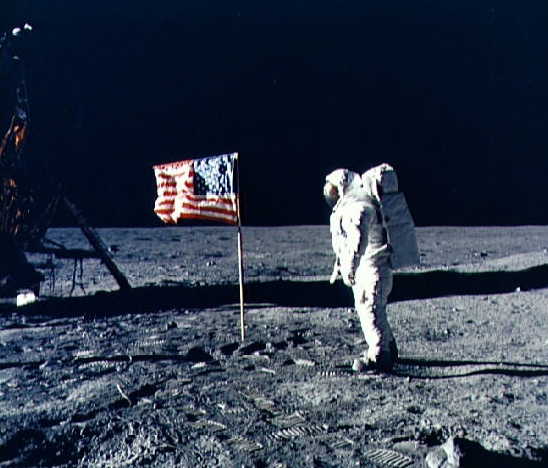
Meanwhile the Soviets and the U.S. wanted to expand their reach beyond Earth's orbit. After much trial and error, on July 20, 1969 Apollo 11 became the first spaceship to land on the Moon and Neil Armstrong became the first man to step on the Moon. The Americans had won the space race.
-Alice Walton

Tuesday, March 2, 2010

The Space Race

The Space Race


The Space Race was a heated competition between the United States and the Soviet Union, as each side tried to match or better the other's accomplishments in exploring outer space. It involved the efforts of both powers to explore outer space with satellites and manned missions, and eventually to land a man on the moon.

The Space Race effectively began after the Soviet launch of Sputnik 1 on October 4, 1957. The world's first artificial satellite was about the size of a beach ball (58 cm.or 22.8 inches in diameter), weighed only 83.6 kg. or 183.9 pounds, and took about 98 minutes to orbit the Earth on its elliptical path. The term "Space Race" originated as an analogy to the arms race. The Space Race became an important part of the cultural, technological, and ideological rivalry between the United States and the Soviet Union during the Cold War.

The Sputnik launch changed everything. As a technical achievement, Sputnik caught the world's attention and the American public off-guard. Its size was more impressive than the Vanguard's intended 3.5-pound payload. In addition, the public feared that the Soviets' ability to launch satellites also translated into the capability to launch ballistic missiles that could carry nuclear weapons from Europe to the U.S. Then the Soviets struck again; on November 3, Sputnik II was launched, carrying a much heavier payload, including a dog named Laika.

Immediately after the Sputnik I launch in October, the U.S. Defense Department responded to the political furor by approving funding for another U.S. satellite project. As a simultaneous alternative to Vanguard, Wernher von Braun and his Army Redstone Arsenal team began work on the Explorer project.

On January 31, 1958, the United States successfully launched Explorer I. This satellite carried a small scientific payload that eventually discovered the magnetic radiation belts around the Earth, named after principal investigator James Van Allen. The Explorer program continued as a successful series of lightweight, scientifically useful spacecraft, establishing the United States as a primary power in space.

After a series of space programs leading up to the Apollo program, the United States finally had the capability to land a man on the moon. The Apollo 11 mission landed Neil Armstrong on the moon on July 20, 1969. This effectively won the Space Race for the United States.

By: Derek Nielsen and Aston Sun